
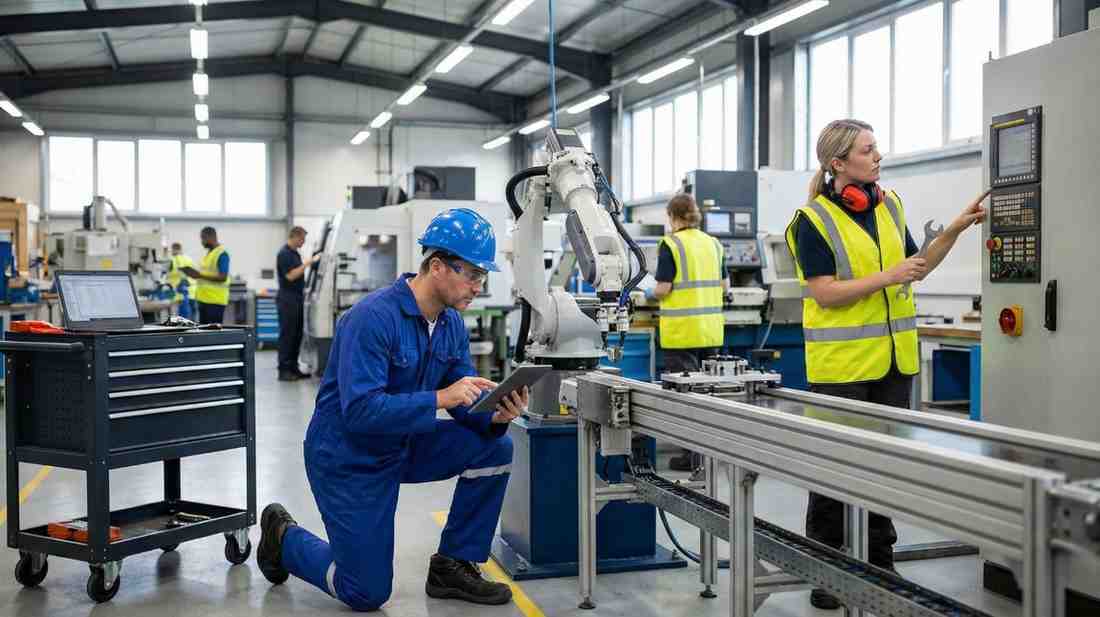
Lean in Aerospace: Process Improvement Under Safety Pressure
Aerospace operations demand precision and traceability. Learn how Lean principles apply in regulated, high-consequence environments without compromising safety or quality.
Aerospace operations demand precision and traceability. Learn how Lean principles apply in regulated, high-consequence environments without compromising safety or quality.
Aerospace organisations operate under some of the most demanding quality and regulatory requirements of any sector. Every component, every process step, and every handover carries consequence. When Lean is mentioned in this context, the immediate concern is predictable: will process improvement compromise the safety, quality, and traceability that our operations depend on?
The answer is no — if Lean is applied properly. In fact, the organisations with the strongest safety and quality cultures are often the ones with the most mature Lean practices. The two are not in tension. They are complementary.
Why aerospace needs Lean
The aerospace sector faces persistent operational challenges. MRO turnaround times are under constant commercial pressure. Supply chains are fragile, with long lead times and single-source dependencies. Programme schedules are complex, with multiple workstreams that must converge precisely. And the cost of rework — both in time and in the additional inspection and documentation it requires — is significantly higher than in less regulated environments.
These are flow problems. They are exactly the kind of challenges that Lean thinking is designed to address. Value stream mapping reveals where work is waiting, accumulating, or being reworked. Standard work stabilises processes so that quality is built in rather than inspected in. Visual management makes the state of work visible to everyone, reducing the risk of errors and omissions.
How Lean works within regulatory frameworks
The key concern in aerospace is that Lean changes will conflict with regulatory and quality requirements — AS9100, NADCAP, military standards, and customer-specific quality clauses. This concern is valid but misplaced. Lean does not require you to change your regulatory framework. It requires you to look at how work moves within that framework and eliminate the waste that is slowing it down.
For example, a standard work instruction in aerospace is not a Lean invention — it is a regulatory requirement. But when multiple versions exist, when the instruction does not reflect the actual method, or when operators have to work around poorly designed documentation, the result is waste: errors, rework, and time spent clarifying requirements. Lean addresses this by aligning documentation with reality and making standards genuinely useful rather than merely compliant.
Similarly, inspection requirements are non-negotiable. But the way inspection is sequenced, the time work waits for inspection, and the rework loops created by late detection of defects are all improvable without touching the compliance framework.
Practical applications of Lean in aerospace
MRO turnaround improvement. MRO operations are ideal for Lean intervention because the value stream is visible, the waste is measurable, and the commercial impact of turnaround time reduction is direct. Value stream mapping an MRO process typically reveals that 60 to 80 per cent of turnaround time is waiting — waiting for parts, waiting for inspection, waiting for engineering decisions, waiting for bay space. Reducing these waits through better scheduling, kitting, and flow management can achieve 20 to 40 per cent turnaround time reductions without changing the technical content of the work.
Cross-shift handover discipline. Shift handovers are a persistent source of waste in aerospace operations. Information is lost, work priorities change, and continuity suffers. Standard handover protocols, visual boards showing work status, and structured handover meetings reduce these losses and improve cross-shift performance.
Supply chain flow. Lean supply chain thinking reduces the bullwhip effect — where small variations in demand are amplified as they move upstream. Better visibility of actual demand, smaller batch sizes, and closer supplier collaboration improve supply chain reliability without increasing inventory.
Production line balancing. In aerospace manufacturing, production lines frequently suffer from bottlenecks where one station's cycle time is significantly longer than others. Line balancing techniques redistribute work content to create more even flow, increasing throughput without additional resources.
Our aerospace experience
Our founder holds a degree in Aerospace Technology and has led Lean transformation work in aerospace engineering and MRO environments. This direct sector experience means we understand both the technical constraints and the cultural dynamics of aerospace organisations. We do not impose generic improvement methods. We design improvements that work within your regulatory framework, respect the complexity of your work, and build the capability of your teams.
If you are looking to improve operational performance in an aerospace or defence environment, book a discovery call to discuss how we can support your specific challenges.

About the author
Audrey Nyamande
Founder, Tacklers Consulting Group
Audrey is a Lean Six Sigma certified aerospace engineer and transformation coach. She has led improvement programmes in high-stakes engineering, manufacturing, and MRO environments across the UK, helping organisations reduce waste, protect expertise, and build capability that lasts.
View speaker profile: Global Lean Summit 2026Learn more about our teamNext steps
Turn insight into practical operational gains
If this topic matches your current priorities, explore our service pathways or book a focused discovery call.
Further reading
Explore our insights

Leadership
Lean Leadership Principles for Operational Managers
Lean leadership is not about tools — it is about how leaders behave, coach, and create the conditions for teams to improve. Learn the core principles every operational manager needs.

Operational Excellence
Operational Excellence Framework: How to Build One That Holds
An operational excellence framework provides the structure for sustained performance improvement. Learn how to design one that aligns strategy, processes, people, and management routines.
Lean Tools
How to Reduce Rework in Production: A Practical Approach
Rework is one of the most expensive forms of waste in production environments. Learn a structured approach to identifying root causes and building quality in at source.
Industry Insights
Lean Manufacturing in the UK: A Practical Guide
UK manufacturing faces persistent productivity challenges. Learn how Lean principles drive measurable improvement in production flow, quality, and delivery reliability.