
What Is Gemba? Why Going to Where the Work Happens Changes Everything
Gemba means the real place — where value is created, problems are visible, and improvement starts. Learn why Gemba walks are the foundation of sustainable Lean transformation.
Gemba means the real place — where value is created, problems are visible, and improvement starts. Learn why Gemba walks are the foundation of sustainable Lean transformation.
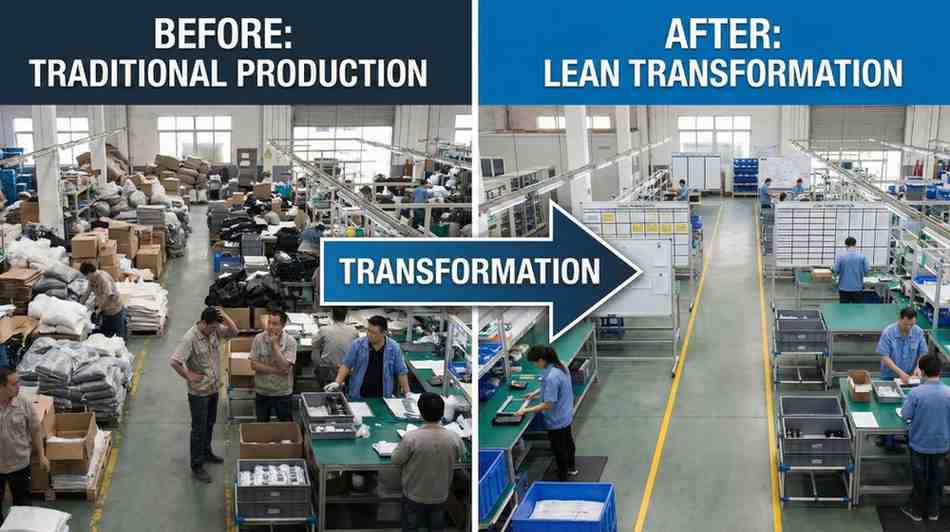
In Japanese, the word Gemba (sometimes written Genba) means the real place — the place where the actual work happens. In a manufacturing context, that is the shop floor. In a hospital, it is the ward or the clinic. In an office, it is the desk where a team processes claims, resolves tickets, or manages orders. Gemba is not a metaphor. It is a physical location, and going there is the single most important leadership practice in Lean.
The concept of Gemba is central to the Toyota Production System and, by extension, to every serious Lean transformation. Taiichi Ohno, the architect of TPS, was famous for drawing a chalk circle on the factory floor and instructing managers to stand in it and observe until they truly understood what was happening. No reports. No dashboards. Just direct observation of how work flows.
Why Gemba matters more than data
Modern organisations have more data than ever — real-time dashboards, KPI reports, automated alerts. Yet the persistent disconnect between what leadership sees and what actually happens on the ground remains one of the biggest barriers to improvement. Data tells you what happened. Gemba shows you why.
When you stand at the point of work and observe, you see things that no report captures: the workaround a team member uses because the standard process does not work, the five-minute wait for a forklift that happens every hour, the handover that requires three phone calls because the system does not support the information needed, the supervisor who spends two hours each morning chasing yesterday's data instead of coaching the team.
These are the realities that drive operational performance. They exist between the lines of every performance report. And they are only visible when you go and look.
The Gemba walk: what it is and what it is not
A Gemba walk is a structured visit to the workplace with the intention of observing work, understanding flow, and engaging with the people doing the work. It is not an inspection. It is not a management tour with a clipboard. And it is emphatically not an opportunity to catch people doing things wrong.
The purpose of a Gemba walk is threefold. First, to observe how work actually flows — where it stops, where it waits, where it goes back for rework, where people have to improvise. Second, to ask questions — not to interrogate, but to understand. What makes your job difficult? Where do you see waste? What would you change if you could? Third, to show respect — by being present, listening, and taking action on what you learn.
The best Gemba walks follow a consistent pattern. The leader arrives with curiosity, not conclusions. They observe before speaking. They ask open questions. They take notes on what they see, not what they think they already know. And crucially, they follow up. If a team raises an issue at Gemba and nothing changes, the trust built during that visit evaporates.
Gemba in practice: beyond manufacturing
While Gemba originated on the factory floor, the principle applies everywhere work is done. In healthcare, Gemba is the clinical pathway — observing how patients move through admission, treatment, and discharge. In IT services, Gemba is the service desk — watching how tickets flow between teams, where handoffs stall, and what causes repeat escalation. In the public sector, Gemba might be a benefits processing centre — observing how cases move through assessment, decision, and notification.
The principle is the same regardless of sector: go to where the work happens, observe how it actually functions, and use that direct knowledge to drive improvement. The moment you try to improve a process you have never observed is the moment you risk solving the wrong problem.
Why most Gemba walks fail
Despite its simplicity, many organisations struggle to make Gemba walks effective. The most common failures include:
Treating Gemba as a tour. When leaders walk through with an entourage, wave to people, and return to their office without taking notes or following up, the walk has no value. It can actually damage trust if teams perceive it as performative.
Coming with answers instead of questions. If a leader arrives at Gemba already knowing what they want to change, the walk becomes a confirmation exercise. The team quickly learns that their input does not matter, and engagement collapses.
Failing to follow through. If issues raised during Gemba walks are never addressed, teams learn to stop raising them. The most corrosive thing a leader can do is ask for problems and then ignore them.
Walking too infrequently. Gemba is not a monthly event. For leaders responsible for operational areas, daily or near-daily Gemba time should be built into their routine. The goal is to make Gemba part of how the leader works, not an additional task layered on top of an already full diary.
Building a Gemba culture
The organisations that get the most from Gemba are those that build it into their management system. This means several things:
Leaders have a Gemba routine — a scheduled, recurring time when they are at the point of work. Not behind a screen, not in meetings, but physically present where the work happens.
Gemba observations are connected to improvement. What leaders see at Gemba feeds into visual management boards, daily meetings, and improvement actions. Observation leads to action, and action leads to results.
Teams expect and welcome Gemba visits. When Gemba is done well, teams look forward to their leader visiting because it means their issues will be heard and addressed. This requires consistent follow-through and a genuine coaching mindset.
Gemba is embedded in the improvement cycle. Whether using PDCA, A3 thinking, or Kaizen events, every improvement effort starts with Gemba. You do not plan an improvement based on what you think is happening — you plan it based on what you observe.
How we use Gemba at Tacklers Consulting Group
Every engagement we undertake starts at Gemba. Before we propose a solution, design an improvement, or recommend a strategy, we go to where the work happens and observe. We watch how materials move, how information flows, how people interact with their processes and with each other.
This is not a formality. It is the foundation of everything we do. We have consistently found that the most impactful improvements come from things observed at Gemba that were invisible in reports, invisible in meetings, and invisible to leaders who had not walked the process recently.
Our approach is to build Gemba capability within your leadership team so that this practice continues long after our engagement ends. We coach leaders on how to conduct effective Gemba walks, how to ask the right questions, how to observe without interfering, and how to follow through consistently.
If you want to understand how Gemba thinking could transform your operational performance, book a discovery call or request an on-site assessment.

About the author
Audrey Nyamande
Founder, Tacklers Consulting Group
Audrey is a Lean Six Sigma certified aerospace engineer and transformation coach. She has led improvement programmes in high-stakes engineering, manufacturing, and MRO environments across the UK, helping organisations reduce waste, protect expertise, and build capability that lasts.
View speaker profile: Global Lean Summit 2026Learn more about our teamNext steps
Turn insight into practical operational gains
If this topic matches your current priorities, explore our service pathways or book a focused discovery call.
Further reading
Explore our insights
Leadership
Lean Leadership Principles for Operational Managers
Lean leadership is not about tools — it is about how leaders behave, coach, and create the conditions for teams to improve. Learn the core principles every operational manager needs.

Operational Excellence
Operational Excellence Framework: How to Build One That Holds
An operational excellence framework provides the structure for sustained performance improvement. Learn how to design one that aligns strategy, processes, people, and management routines.
Lean Tools
How to Reduce Rework in Production: A Practical Approach
Rework is one of the most expensive forms of waste in production environments. Learn a structured approach to identifying root causes and building quality in at source.
Industry Insights
Lean Manufacturing in the UK: A Practical Guide
UK manufacturing faces persistent productivity challenges. Learn how Lean principles drive measurable improvement in production flow, quality, and delivery reliability.